
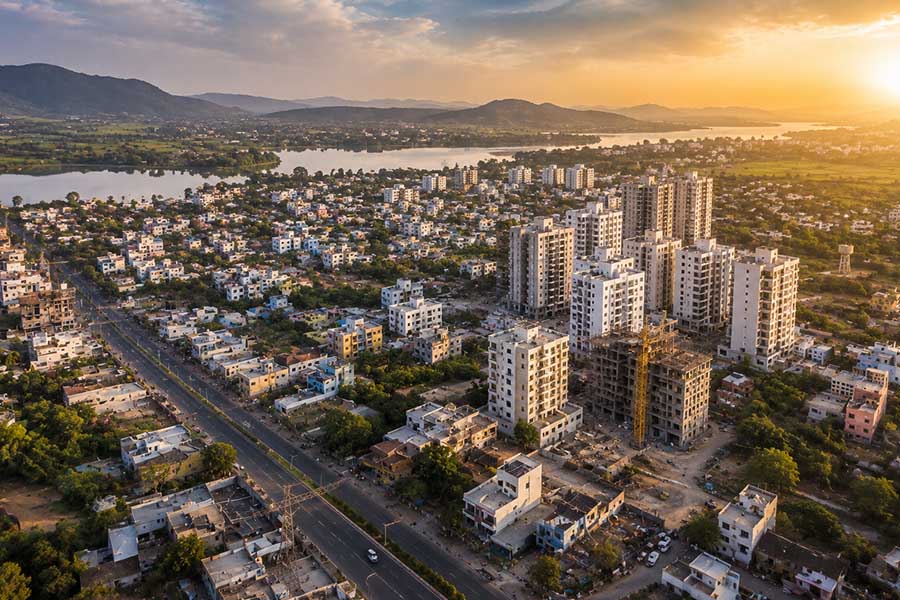
Tier-II Cities
Why Real Estate Values in Maharashtra’s Tier-II Cities Continue to Demonstrate Market Resilience
A common question among investors, developers, lenders and policymakers is:
Why do residential property values in Maharashtra’s Tier-II cities such as Nashik, Chhatrapati Sambhajinagar, Kolhapur, Solapur and Nagpur remain resilient despite persistent infrastructure challenges?
At first glance, the contradiction appears obvious. Many of these cities continue to face:
- Intermittent water supply
- Uneven road infrastructure
- Traffic congestion
- Urban encroachments
- Parking shortages
- Infrastructure gaps arising from rapid urbanisation
Yet these issues alone rarely determine long-term real estate performance.
Economic Fundamentals Drive Property Values
Real estate is fundamentally an economic asset, not merely an infrastructure-dependent commodity.
Property values are primarily influenced by:
- Employment generation
- Commercial and industrial activity
- Household income
- Population growth
- Occupancy demand
Maharashtra’s Tier-II cities continue to benefit from:
- Strong SME and industrial clusters
- Robust wholesale and retail trade
- Agriculture-linked regional economies
- Reputed educational institutions
- Expanding healthcare infrastructure
- Stable employment across manufacturing, services, logistics, education and healthcare
Unlike commuter cities, these centres generate substantial local economic activity, reducing dependence on Mumbai or Pune.
Urban Efficiency Matters
Infrastructure quality certainly affects quality of life, but urban efficiency often has a greater impact on everyday living.
While metropolitan residents may spend hours travelling short distances, many Tier-II cities still allow quicker access to workplaces, schools, hospitals and commercial centres.
This operational efficiency supports productivity and strengthens long-term residential demand.
The Real Driver of Housing Demand
From a valuation perspective, the critical question is not:
“How wide are the roads?”
It is:
“Can the city continue to generate sustainable demand for living, working and doing business?”
Cities with sustained:
- Employment
- Business activity
- Educational institutions
- Healthcare facilities
- Entrepreneurship
- Economic diversification
- Population growth
generally demonstrate greater resilience in their real estate markets.
Sustainable Appreciation Over Speculation
Tier-II cities may not always deliver rapid speculative gains seen in select metropolitan markets.
However, they often offer:
- Stable end-user demand
- Lower speculative volatility
- Consistent residential absorption
- Strong owner-occupier participation
- Sustainable rental demand
- Gradual but resilient capital appreciation
These characteristics typically result in lower downside risk over long market cycles.
A Valuer’s Perspective
Infrastructure remains an important contributor to property value, but it is only one component of a broader economic framework.
The long-term value of real estate ultimately depends on a city’s ability to:
- Generate employment
- Sustain business activity
- Attract population growth
- Maintain economic productivity
In simple terms, employment is the strongest form of infrastructure supporting real estate values.
Professional Disclaimer
The views expressed are based on macroeconomic analysis and professional valuation experience and are intended solely for educational and informational purposes. They do not constitute legal, financial, investment or valuation advice. Real estate values are influenced by numerous factors, including regulatory changes, infrastructure investment, financing conditions, taxation, demographics and local market dynamics. Every investment decision should therefore be supported by appropriate legal, technical, financial and valuation due diligence.
Umesh Deshpande
Managing Director, Shilp Consultant & Valuers Pvt. Ltd.
Registered Valuer (Income Tax Act & IBBI)
Chartered Engineer
Real Estate Analyser